
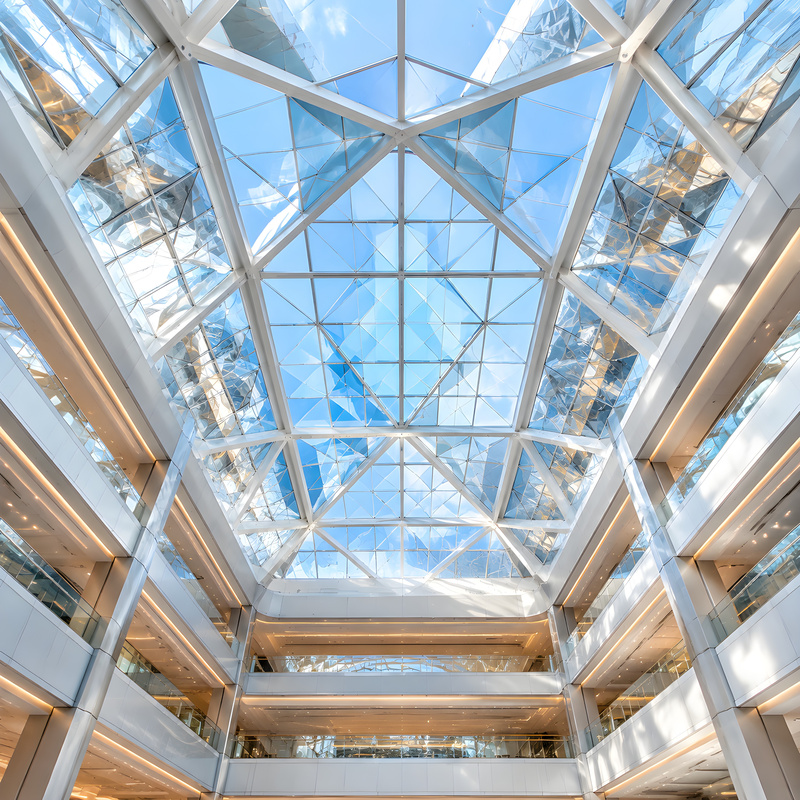
One pane has failed. The sealed unit has misted, or a crack has run across it, and everything around it is sound. The building owner wants that one piece of glass changed and nothing else touched, which is entirely reasonable and more complicated than it sounds.
Glazed roofs are assemblies. Panes sit in a framework held together by pressure plates, gaskets and sealant, and removing one without disturbing its neighbours takes a method rather than a crowbar.
Find out what’s actually up there first
The survey comes before anything, and it’s the stage most often rushed.
The replacement unit has to match the original in thickness, make-up and edge detail, because the rebate was set for a specific dimension. Get the overall thickness wrong and the pressure plate won’t clamp properly, or won’t close at all.
It has to match optically too. Coated glass carries a tint, and coatings have changed over the years, so a modern equivalent of a twenty-year-old solar control product can read noticeably different in daylight. From the floor of an atrium, a single pane with a slightly green cast against forty neutral ones is the only thing anyone will look at.
Measuring is the other trap. Older atria weren’t built to tight tolerances, and panes that look like a repeating module frequently aren’t. Measure the actual aperture rather than scaling it off a drawing, and allow for the fact that the aperture may not be square.
Weight gets checked as well, since a modern unit of the same thickness can be heavier than what’s coming out, and the glazing bars and the lifting method both care about that.
Getting to it and getting it out
Access is the expensive half. The method depends on the atrium rather than the pane: rope access where there’s structure to rig from, a mobile platform where the floor can carry it, a building maintenance unit if one exists and has been tested.
The floor loading question comes up again and again on these jobs, because a lobby slab over a basement is a common arrangement and a machine at full extension puts a lot of load through small footprints. That’s a structural answer, not a contractor’s opinion, and the Health and Safety Executive’s work at height guidance covers the planning obligations around the rest of it.
Removal itself is the moment of highest risk. An old pane can be under more stress than it looks, particularly if the framework has moved, and glass that has been in place for two decades sometimes breaks during extraction rather than during handling. Everything below has to be protected on the assumption that it will.
Pressure plates come off in sequence. Old sealant gets cut out rather than dug out, because gouging the rebate creates a surface that nothing new will bond to properly. On a system with structurally bonded glazing the removal is a different exercise again and usually a slower one.
Putting the new unit in
The rebate gets cleaned back to a sound substrate and the drainage path gets cleared, which is the step that quietly prevents the next leak. Weep holes blocked during the works stay blocked unless someone checks them.
New gaskets go in rather than the old ones going back. Gaskets shrink and harden, and a twenty-year-old gasket reinstated around a brand new unit is a leak waiting for a wet autumn.
Setting blocks matter more than their size suggests. They carry the weight of the pane and keep the glass off the frame, and getting them in the wrong position transfers load into a corner of the unit and cracks it months later.
Then the perimeter seal, applied in the right temperature range onto a dry substrate, and a water test on that bay before anyone leaves site. Testing as you go is the difference between a repair and an investigation.
Lead time is the thing to plan around
Made-to-measure units take weeks, and a coated or laminated unit in a non-standard size isn’t coming off a shelf. That gap has to be covered, which usually means a temporary panel or a weathering cover, and it has to hold up to whatever the weather does in the meantime.
Knowing the lead time before the access is booked saves paying for a platform twice. Where several panes are suspect, surveying all of them and ordering together is generally cheaper than three separate mobilisations, and the thinking is the same as sizing the right machine once rather than hiring twice.
Portfolio owners tend to handle this better than single-building owners, because separating access from materials when forecasting glazing spend makes the repeat mobilisation cost visible rather than absorbing it into a repair line.
Firms handling atrium glass replacement as a single discipline, access included, avoid the handover where responsibility for weathertightness gets blurred between two contractors.
If a quote for one pane arrives without a survey having happened, it’s an estimate for a piece of glass and the access will be priced later. Ask for both together, or the number will move.